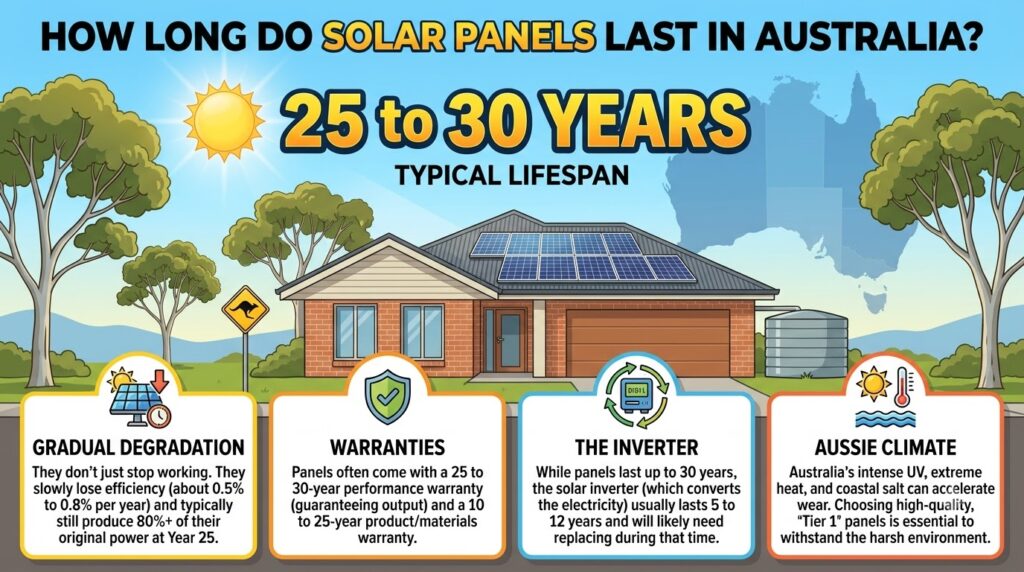
Installing solar panels is a long-term investment, so one of the most common questions Australian homeowners ask is: How long do solar panels actually last?
Modern solar panels are designed for long-term outdoor use, but their performance, condition and lifespan can depend on product quality, installation, weather exposure, maintenance and the overall design of the solar system.
For homeowners considering residential solar, understanding expected panel lifespan can help with system planning, budgeting and long-term energy decisions.
At Nationwide Solar Pty Ltd, we provide complete solar solutions for Australian homes and businesses. With more than 10 years of solar industry experience, we understand that a good solar system should be designed not only for today’s electricity requirements but also with long-term performance and future energy needs in mind.
What Is the Typical Lifespan of Solar Panels?
Quality solar panels are generally designed to operate for many years.
However, the useful life of a solar system should not be confused with a specific warranty period.
Over time, solar panels may gradually produce less electricity than when they were new. This gradual change is known as solar panel degradation.
A panel does not normally stop working simply because it reaches a certain age. Instead, its electricity production may slowly reduce over its operating life.
The exact long-term performance depends on the manufacturer, panel technology, installation conditions and environment.
What Is Solar Panel Degradation?
Solar panel degradation refers to the gradual reduction in a panel’s ability to generate electricity over time.
All solar panels are exposed to outdoor conditions such as:
- Sunlight
- Heat
- Rain
- Wind
- Temperature changes
- Dust
- Moisture
- Coastal conditions in some locations
Because panels operate outdoors continuously, some gradual change in performance is expected.
Manufacturers may provide performance information showing how their panels are expected to perform over a specified period.
When comparing solar systems, homeowners should look beyond the initial panel output and consider long-term manufacturer information and warranty conditions.
Does Australian Weather Affect Solar Panel Lifespan?
Australia experiences a wide range of environmental conditions.
Depending on where a property is located, solar panels may be exposed to intense sunshine, high temperatures, storms, dust, coastal air and seasonal weather changes.
Solar equipment selected for Australian homes should therefore be appropriate for the local environment.
Factors that can affect long-term system condition include:
- Extreme heat
- Strong sunlight
- Coastal salt exposure
- Dust
- Heavy rainfall
- Wind
- Nearby vegetation
- Bird activity
A professionally designed system should consider the property and environmental conditions before equipment is selected.
Quality of Installation Matters
Even good solar equipment needs to be installed correctly.
Professional installation can have a major influence on how well the system operates over the long term.
Installation should consider:
- Panel positioning
- Mounting system
- Roof condition
- Cable routing
- Inverter location
- Electrical setup
- Roof access
- Shading
- Ventilation around panels
Poor installation may create unnecessary issues even when quality equipment is used.
At Nationwide Solar Pty Ltd, we assess the property before developing the solar design so the installation is planned around actual site conditions.
Solar Panel Quality Is Important
Not all solar panels are identical.
When choosing panels, homeowners may consider:
- Manufacturer reputation
- Product specifications
- Performance warranty
- Product warranty
- Panel efficiency
- Suitability for the property
- Long-term manufacturer support
A solar system should not be selected based solely on the lowest upfront price.
The quality of the panels, inverter, mounting equipment and overall installation should all be considered together.
How Long Does a Solar Inverter Last?
The inverter is another important component of a solar system.
Solar panels and inverters perform different functions, and their expected service life may not be identical.
An inverter converts the electricity produced by the solar panels into electricity that can be used within the property.
Over the life of a solar system, the inverter may require servicing or replacement before the panels themselves need replacing.
This is one reason homeowners should think about the complete system rather than focusing only on the solar panels.
Can Solar Panels Last Longer with Proper Maintenance?
Solar panels are generally designed to require relatively limited routine maintenance, but homeowners should still keep an eye on the condition of the system.
Good solar care may include:
- Monitoring system performance
- Watching for unusual output changes
- Checking for new shading
- Managing bird activity
- Addressing significant dirt or debris
- Arranging professional inspections when necessary
Regular awareness can help identify issues before they become larger maintenance concerns.
Solar Panel Cleaning
Dust, bird droppings, leaves and other debris can sometimes collect on panels.
The amount of cleaning required varies depending on the property and environment.
Homes near busy roads, industrial areas, trees or locations with high bird activity may experience more dirt or debris than other properties.
Rain may remove some light dust, but it may not remove all material.
Where professional cleaning is needed, it should be carried out safely because rooftop solar systems involve both working at height and electrical equipment.
Bird Protection Can Help Keep the Solar Area Cleaner
Birds can sometimes nest underneath solar panels because the gap between the panels and roof provides shelter.
Bird nesting can lead to:
- Feathers
- Droppings
- Twigs
- Nesting material
- Noise
- Additional maintenance
Installing solar panel bird mesh can help prevent birds from accessing the area beneath the solar array.
Nationwide Solar provides bird mesh protection for suitable new and existing solar systems.
Bird mesh does not increase the lifespan of the panels directly, but it can help keep the surrounding roof and panel area more manageable.
Monitor Your Solar System
Solar monitoring can be useful for understanding how a system performs over time.
Depending on the equipment installed, monitoring may allow homeowners to view:
- Daily generation
- Monthly production
- Historical performance
- System status
It is normal for solar generation to change throughout the year because of weather and seasonal conditions.
However, an unexpected or persistent reduction in performance may be worth investigating.
Understanding normal system performance can make unusual changes easier to recognise.
Watch for Shading Changes
Solar panel performance can change even when the panels themselves are operating normally.
One common reason is new shading.
Trees can grow over time and begin casting shadows across sections of the roof.
New buildings or roof structures can also change solar exposure.
Homeowners should occasionally consider whether:
- Trees have grown significantly
- New buildings are creating shade
- Roof equipment has been added
- Nearby structures have changed
Managing new shading can help keep the system operating closer to its intended design.
What Happens When Solar Panels Get Older?
Older solar panels do not necessarily stop producing electricity.
Instead, their output may gradually decline.
Eventually, homeowners may decide that replacing an older system makes sense because:
- Electricity requirements have increased
- Panel technology has changed
- The existing system is too small
- An EV has been added
- Battery storage is being considered
- The property has been renovated
- Existing equipment requires significant work
The decision should be based on system condition and household energy requirements rather than age alone.
Can You Upgrade an Older Solar System?
Sometimes homeowners want more solar capacity before their existing panels have reached the end of their useful life.
For example, electricity consumption may increase because of:
- Electric vehicle charging
- Additional air conditioning
- Electric hot water
- Pool equipment
- Home renovations
- New appliances
- Battery storage
Whether an existing system can be expanded or should be replaced depends on the equipment, roof space, electrical setup and current system condition.
A professional assessment can help determine the most practical approach.
Solar Panels and Future EV Charging
When installing a new solar system, homeowners should consider future EV requirements.
An electric vehicle can significantly increase household electricity demand.
If your current solar system is designed only around today’s electricity usage, it may eventually become too small for your future needs.
Discussing EV plans during the initial solar assessment can help create a more suitable long-term system.
Solar Panels and Battery Storage
Battery storage is another future consideration.
A battery may allow some solar-generated electricity to be stored for later use.
If battery storage is part of your long-term plan, it can be useful to discuss this before choosing your solar equipment.
Solar, batteries and EV charging can all form part of one integrated home energy strategy.
Complete Solar Solutions for Australian Homes and Businesses
Nationwide Solar Pty Ltd manages the complete solar journey from initial property assessment and system design through to professional installation and after-sales support.
Our services can include:
- Residential solar
- Commercial solar
- Property assessment
- Energy usage review
- Custom solar system design
- Professional installation
- EV charger installation
- Solar integration planning
- Battery considerations
- Bird mesh protection
- System monitoring guidance
- After-installation support
With more than 10 years of solar industry experience, we understand that every property has different electricity and long-term energy requirements.
Why Choose Nationwide Solar Pty Ltd?
Nationwide Solar focuses on providing property-specific solar solutions.
Before recommending a system, we consider:
- Electricity usage
- Roof space
- Roof orientation
- Shading
- Property conditions
- Budget
- EV requirements
- Battery plans
- Future electricity demand
This helps us develop a solar solution designed around both current and future requirements.
Final Thoughts
Solar panels are designed as long-term energy equipment, but their performance and lifespan depend on several factors.
Choosing quality equipment, having the system professionally designed and installed, monitoring performance and addressing maintenance issues can all help protect your solar investment.
Homeowners should also consider future electricity needs when choosing a system, particularly if they plan to add an EV, battery storage or additional electrical appliances.
If you are considering installing or upgrading residential solar, Nationwide Solar Pty Ltd can assess your property and recommend a system based on your individual energy requirements.
Nationwide Solar Pty Ltd — Complete Solar Solutions for Australian Homes and Businesses.