
As more Australian homeowners look for ways to manage electricity costs and make better use of renewable energy, two technologies often come up in the same conversation: solar panels and home battery storage.
Both can play an important role in a household energy system, but they do different jobs.
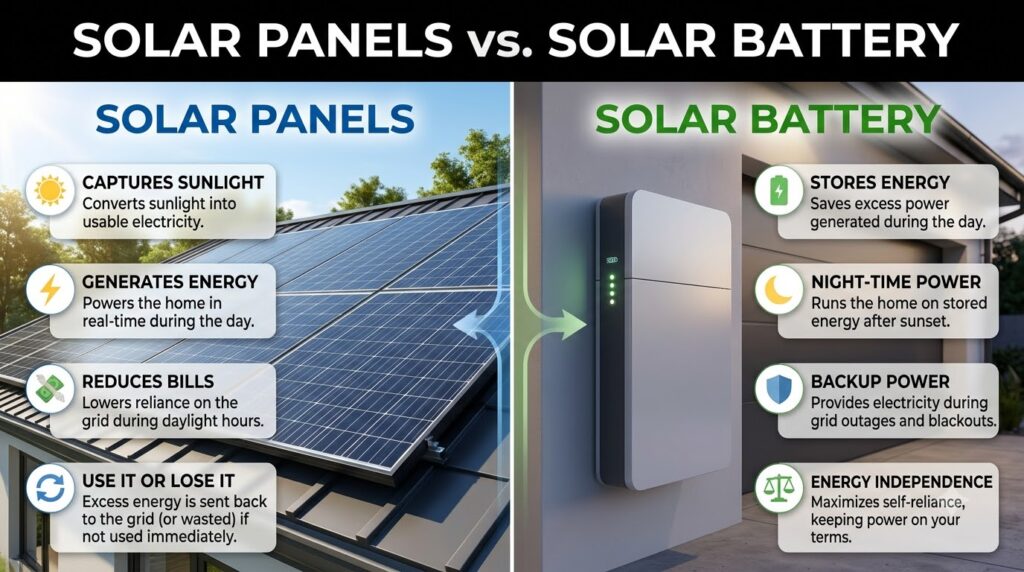
Solar panels generate electricity during daylight hours, while a battery stores electricity so it can potentially be used later. For many homeowners, the main question is whether they should install solar panels first, add a battery at the same time, or plan for battery storage in the future.
At Nationwide Solar Pty Ltd, we help Australian homeowners assess their electricity usage, property conditions and future energy requirements before recommending a suitable solution.
With more than 10 years of solar industry experience, we understand that the right choice depends on the individual home rather than following a one-size-fits-all approach.
What Do Solar Panels Do?
Solar panels generate electricity from sunlight.
When sunlight reaches the panels, the solar system produces electricity that can be used within the home.
During the day, this electricity may help power:
- Air conditioning
- Refrigerators
- Washing machines
- Dishwashers
- Pool equipment
- Home office equipment
- Electric hot water
- EV chargers
- Other household appliances
If the solar system is producing electricity at the same time your home is using power, some of that solar energy may be consumed directly.
This can reduce the amount of electricity that needs to be purchased from the grid during those periods.
What Does a Solar Battery Do?
A solar battery stores electricity for later use.
For example, your solar system may generate more electricity during the middle of the day than your household needs at that moment.
Depending on the system configuration, some of that energy may potentially be stored in a battery rather than being used immediately.
The stored electricity may then be available later, such as in the evening when solar panels are no longer producing energy.
Battery performance and usefulness depend on several factors, including:
- Solar system size
- Household electricity consumption
- Battery capacity
- Daytime energy usage
- Evening energy usage
- Electricity tariffs
- Charging and discharge settings
- Property requirements
A battery should therefore be selected based on the home’s overall energy profile.
Solar Panels and Batteries Perform Different Roles
One of the most important things to understand is that solar panels and batteries are not direct alternatives.
Solar panels are the energy generator.
A battery is primarily an energy storage system.
Without solar panels, a battery does not generate renewable electricity by itself.
For many homeowners considering a complete solar energy system, installing suitable rooftop solar is therefore the starting point.
Battery storage can then be considered based on how much electricity the household generates, consumes and wants to store.
Should You Install Solar Panels First?
For many Australian homes, solar panels may be the logical first step.
Installing solar allows the property to begin generating electricity during daylight hours.
It also gives homeowners an opportunity to understand:
- How much solar electricity the system produces
- How much electricity is used during the day
- How much excess solar generation may be available
- How much electricity is still purchased from the grid
- Whether evening electricity usage is high
Once this information is available, it may be easier to determine whether battery storage would provide a useful addition.
However, this does not mean every homeowner should automatically delay battery installation.
If battery storage is already part of your energy plan, it can be considered during the original solar design.
When Does Installing Solar and a Battery Together Make Sense?
Some homeowners prefer to plan solar panels and battery storage as one integrated project.
This can make sense when the household already has a clear understanding of its energy requirements.
For example, homeowners may want to consider solar and battery together if they:
- Use significant electricity in the evening
- Want to increase their use of solar-generated electricity
- Are building a new home
- Are completing a major electrical renovation
- Plan to add an electric vehicle
- Want a coordinated energy system from the beginning
- Have clearly defined long-term energy goals
The right approach depends on the property and budget.
A professional assessment can help determine whether solar-only or solar-plus-battery installation is more suitable.
Consider Your Daytime Electricity Usage
Daytime energy usage is one of the most important factors when comparing solar panels and battery storage.
If your household uses a large amount of electricity while the sun is shining, you may be able to use more solar electricity directly.
This could include households where:
- Someone works from home
- Air conditioning runs during the day
- Pool pumps operate during daylight hours
- Electric appliances are scheduled during the day
- An EV is charged while solar is producing
In these situations, rooftop solar may already offset a portion of daytime grid electricity.
The role of battery storage may then depend more heavily on evening and overnight electricity usage.
Consider Your Evening Electricity Usage
Many Australian households consume significant electricity after sunset.
Evening electricity use may include:
- Cooking
- Heating or cooling
- Lighting
- Television
- Laundry
- Electric hot water
- EV charging
- General appliance usage
Because solar panels do not produce electricity after sunset, this energy would usually need to come from the grid unless stored energy is available.
This is where battery storage may become relevant.
A battery may allow some electricity generated earlier in the day to be used later.
However, battery size and suitability should be matched carefully to the household’s energy consumption.
How Much Battery Storage Do You Need?
There is no single battery size that is suitable for every home.
The right capacity depends on factors such as:
- Daily electricity usage
- Evening electricity consumption
- Solar generation
- Existing solar system size
- Household lifestyle
- EV charging
- Future appliances
- Budget
Installing the largest available battery is not automatically the best approach.
A battery should be selected based on realistic household usage and expected solar generation.
Can You Add a Battery to Existing Solar Panels?
In many cases, homeowners with an existing solar system may be able to add battery storage later.
However, compatibility needs to be assessed.
Factors may include:
- Existing inverter type
- Solar system configuration
- System age
- Battery requirements
- Available installation space
- Electrical infrastructure
If you think you may add a battery in the future, it is useful to discuss this when designing a new solar system.
Planning ahead can make future decisions easier.
Solar Battery and EV Charging
Electric vehicles can significantly change a household’s electricity profile.
Charging an EV may require considerably more electricity than traditional household appliances.
If you already own an EV or expect to purchase one, this should be considered when planning both solar and battery storage.
Questions to consider include:
- Will the EV charge during the day?
- Will most charging happen overnight?
- How far is the vehicle driven each day?
- Will there eventually be two EVs?
- Is the solar system large enough for future demand?
For homeowners who can charge their EV during daylight hours, direct solar charging may be an attractive option.
Households that mainly charge at night may need a different energy strategy.
Future-Proofing Your Home Energy System
Electricity requirements can change considerably over time.
A home that has relatively modest electricity usage today may use much more power in the future.
Possible changes include:
- Purchasing an EV
- Adding a second EV
- Installing more air conditioning
- Replacing gas appliances with electric appliances
- Adding a swimming pool
- Installing electric hot water
- Working from home
- Renovating or extending the property
These future requirements should be considered when planning solar and battery storage.
A well-designed system should account for where practical not only current demand but also likely future energy needs.
Should Price Be the Main Factor?
Cost is naturally important, but it should not be the only factor when deciding between solar panels and battery storage.
Homeowners should also consider:
- Household electricity profile
- Roof suitability
- Solar system size
- Battery capacity
- Equipment compatibility
- Installation quality
- Monitoring features
- Future energy requirements
- After-sales support
The cheapest combination may not necessarily be the most suitable one.
The objective should be to create a balanced system that makes sense for the property.
Solar Monitoring Can Help With Battery Decisions
Solar monitoring can be useful if you are considering adding battery storage later.
Depending on the installed equipment, monitoring may help you understand:
- How much electricity your solar system generates
- When generation is highest
- When household consumption is highest
- How much solar is being used directly
- When grid electricity is being purchased
This information can provide a clearer picture of whether battery storage may fit your household’s energy profile.
Complete Solar and Battery Planning
At Nationwide Solar Pty Ltd, we take a complete approach to residential energy planning.
Our services can include:
- Household energy assessment
- Property and roof assessment
- Custom solar system design
- Professional solar installation
- Battery planning
- EV charging considerations
- System monitoring guidance
- After-installation support
Rather than treating solar panels, batteries and EV chargers as completely separate products, we consider how they may work together as part of your property’s overall energy requirements.
Which Should You Install First?
For many homeowners, solar panels are the natural starting point because they generate the electricity that a solar battery can later store.
However, the right choice depends on your household.
You may consider installing solar first if:
- You want to begin generating rooftop solar electricity
- Your daytime electricity usage is high
- You want to review your actual solar production before choosing a battery
- Battery storage is not currently within your budget
Installing solar and a battery together may make sense if:
- Evening energy use is significant
- You already understand your electricity profile
- You want an integrated system from the start
- Battery storage is already part of your long-term plans
A professional assessment is the best way to determine which approach suits your property.
Final Thoughts
Solar panels and batteries can complement each other, but they perform different roles.
Solar panels generate electricity during daylight hours, while battery storage may allow some of that electricity to be used later.
For many Australian homeowners, installing a properly designed solar system is the first step. Battery storage can then be added immediately or considered later based on electricity consumption, solar production, budget and future energy plans.
Before making a decision, assess your household electricity usage, roof space, daytime and evening demand, EV plans and long-term requirements.
Nationwide Solar Pty Ltd — Complete Solar Solutions for Australian Homes and Businesses.