
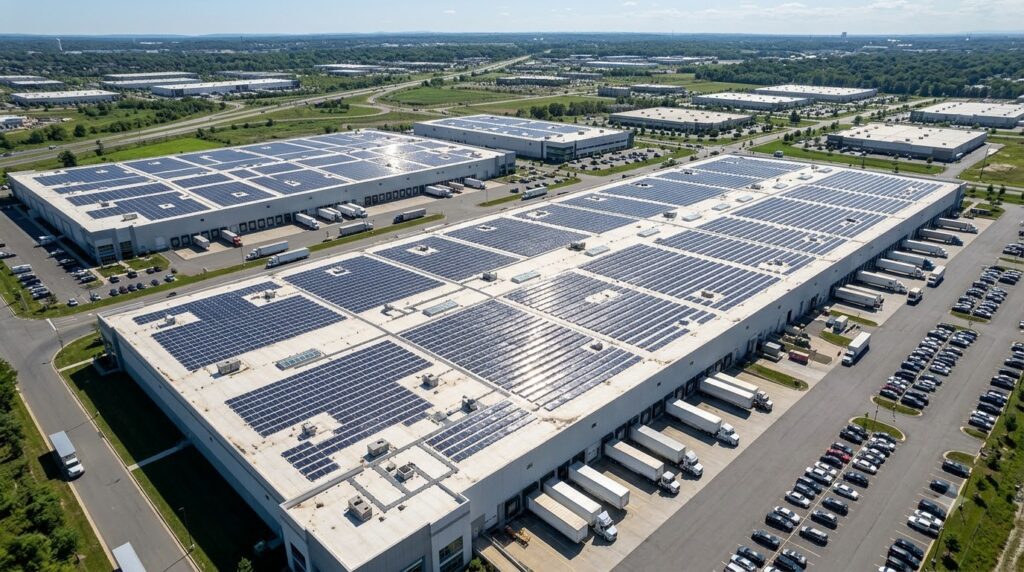
Warehouses, factories, offices and other commercial buildings can have significant electricity requirements, particularly during normal business hours. At the same time, many commercial properties have large roof areas that may be suitable for solar panels.
This combination can make commercial solar an important option for Australian businesses looking to reduce reliance on grid electricity and improve the way they manage long-term energy costs.
At Nationwide Solar Pty Ltd, we provide commercial solar solutions designed around the electricity usage, roof space, operating hours and future plans of each business. With more than 10 years of solar industry experience, we understand that a warehouse or commercial building needs a different approach from a residential property.
This guide explains what businesses should consider before installing solar panels on a warehouse or commercial building.
Why Warehouses Can Be Suitable for Solar Panels
Warehouses often have large, relatively open roof areas.
This may provide substantial space for installing solar panels, but roof size alone does not determine whether a system will be suitable.
A commercial solar assessment should also consider:
- Electricity consumption
- Business operating hours
- Roof orientation
- Shading
- Roof condition
- Existing rooftop equipment
- Electrical infrastructure
- Future business growth
- Battery storage plans
- EV charging requirements
A large roof may create strong solar potential, but the system should still be designed around the way the property actually uses electricity.
Understand the Business Energy Profile
Every commercial property has a different electricity profile.
A warehouse used mainly for storage may have relatively low electricity consumption, while another site may operate refrigeration, lighting, machinery, ventilation systems or production equipment.
This difference can significantly affect the size and design of the solar system.
Before recommending a system, Nationwide Solar may review:
- Electricity bills
- Daytime energy demand
- Peak operating periods
- Machinery loads
- Lighting requirements
- Air conditioning
- Refrigeration
- Operating hours
- Seasonal changes
- Expected future demand
This helps ensure the solar system is matched to the business rather than simply sized according to available roof space.
Why Daytime Electricity Use Matters
Solar panels generate electricity during daylight hours.
For many businesses, this can align well with normal operating times.
Warehouses, offices and commercial facilities may use electricity throughout the day for:
- Lighting
- Computers
- Machinery
- Air conditioning
- Ventilation
- Refrigeration
- Pumps
- Production equipment
When the business is using electricity at the same time the solar system is generating, more solar electricity may be consumed directly on-site.
This may help reduce the amount of electricity purchased from the grid during those periods.
Commercial Roof Assessment
The roof is one of the most important parts of a commercial solar project.
A proper assessment should review the available installation area and any features that may affect the panel layout.
Important roof considerations include:
- Roof orientation
- Roof pitch
- Structural condition
- Shading
- Skylights
- Ventilation systems
- Air conditioning units
- Roof access
- Existing equipment
- Drainage points
- Future maintenance requirements
Some commercial roofs may appear simple from ground level but contain multiple areas that cannot be used for panels.
A detailed site review helps create a practical solar layout.
Solar for Warehouses
Warehouses can be strong candidates for commercial solar because of their roof area and daytime operation.
However, system design should still reflect the actual business use.
For example, a distribution warehouse may use electricity for:
- Lighting
- Forklift charging
- Office areas
- Security systems
- Conveyor equipment
- Ventilation
- Loading systems
A cold-storage warehouse may have much higher energy demand due to refrigeration equipment.
These two properties may require very different solar solutions even if their roof size is similar.
Solar for Office Buildings
Office buildings also have consistent daytime electricity consumption.
Typical office loads include:
- Computers
- Servers
- Lighting
- Air conditioning
- Elevators
- Kitchen equipment
- Printers
- Meeting room technology
Because many office activities occur during daylight hours, commercial solar may align well with the building’s energy use.
The solar system should still be designed around total consumption, roof space and future requirements.
Solar for Retail and Commercial Properties
Retail and mixed-use commercial buildings can also benefit from a detailed solar assessment.
Retail energy use may include:
- Refrigeration
- Lighting
- Air conditioning
- Display equipment
- Signage
- Point-of-sale systems
- Security systems
Some businesses operate seven days a week, while others have shorter trading hours.
This affects how solar generation may be used across the property.
Commercial Solar System Size
There is no single solar system size that is right for every warehouse or commercial building.
The correct system size depends on:
- Electricity consumption
- Daytime usage
- Roof space
- Roof orientation
- Shading
- Budget
- Electrical infrastructure
- Future expansion
- Battery plans
- EV charging demand
A larger system is not automatically the best choice.
The goal should be to create a system that works with the site’s electricity usage and long-term energy strategy.
Plan for Future Business Growth
Commercial solar should be planned with the future in mind.
Businesses may expand their operations over time.
Future changes could include:
- Additional machinery
- Increased staff
- Longer operating hours
- More refrigeration
- New office areas
- Electric vehicle fleets
- EV charging stations
- Battery storage
- Additional buildings
These changes may increase electricity demand.
Discussing future plans during the initial assessment can help create a more forward-looking solar strategy.
EV Charging for Commercial Properties
Electric vehicle charging is becoming increasingly relevant for businesses.
Warehouses and commercial buildings may eventually require EV chargers for:
- Company vehicles
- Staff cars
- Delivery vehicles
- Customer vehicles
- Electric fleets
EV charging can add significant electricity demand to a commercial site.
If your business plans to install EV chargers in the future, this should be considered when planning the solar system.
Nationwide Solar can review commercial solar and EV charging as part of one broader energy solution.
Battery Storage Considerations
Battery storage may also become part of a commercial energy strategy.
A battery may allow some solar-generated electricity to be stored for later use.
However, battery suitability depends on:
- Solar generation
- Business operating hours
- Evening electricity usage
- Electricity tariffs
- Battery capacity
- Business objectives
Not every commercial property will have the same battery requirements.
For this reason, battery storage should be considered alongside the overall energy profile.
Professional Commercial Solar Installation
Commercial solar installations require careful coordination.
Warehouse and commercial properties may have:
- Staff on-site
- Customer access
- Deliveries
- Loading bays
- Machinery
- Security requirements
- Restricted work areas
Installation therefore needs to be planned around normal business operations.
Nationwide Solar works to coordinate commercial installation schedules in a way that reduces unnecessary disruption where practical.
Installation Safety and Site Access
Commercial sites can be more complex than residential homes.
Access to the roof may require specific planning, and work may need to be coordinated around staff, vehicles and equipment.
The installation process may consider:
- Roof access
- Working areas
- Delivery schedules
- Vehicle movement
- Electrical shutdown requirements
- Existing infrastructure
- Site safety procedures
A professional installation plan helps ensure the project is managed properly from start to finish.
Monitoring Commercial Solar Performance
Many commercial solar systems include monitoring functionality.
Depending on the equipment installed, businesses may be able to view:
- Solar generation
- System performance
- Daily output
- Historical production
Monitoring can help businesses better understand how the system is operating.
It may also help identify when energy-consuming activities could be shifted to daylight hours to make greater use of on-site solar generation.
Solar as Part of a Business Energy Strategy
Commercial solar should not be viewed only as a roof installation.
It can form part of a broader business energy strategy that may include:
- Energy efficiency
- Solar generation
- EV charging
- Battery storage
- Equipment upgrades
- Future electrification
A business that plans all of these elements together may be better prepared for changing electricity requirements.
Nationwide Solar takes this wider view when assessing commercial properties.
Complete Solar Solutions for Australian Businesses
Nationwide Solar Pty Ltd manages the complete commercial solar journey from initial assessment through to system design, professional installation and after-sales support.
Our commercial solar services can include:
- Business energy assessment
- Warehouse solar assessment
- Commercial property review
- Electricity usage analysis
- Roof layout assessment
- Custom solar system design
- Professional installation
- Installation scheduling
- Monitoring guidance
- Battery considerations
- EV charging planning
- Ongoing support
With more than 10 years of practical solar industry experience, we understand that every warehouse and commercial building has different energy requirements.
Why Choose Nationwide Solar Pty Ltd?
Nationwide Solar takes a customised approach to commercial solar.
We do not recommend systems based only on roof size.
Instead, we consider the complete property, including energy usage, site conditions and future plans.
Our approach is suitable for:
- Warehouses
- Office buildings
- Retail properties
- Industrial facilities
- Workshops
- Commercial sites
This helps us create a system that is more closely aligned with the business.
Final Thoughts
Warehouses and commercial buildings can offer significant opportunities for solar because of their roof space and daytime electricity usage.
However, the right commercial solar system should be designed around much more than available roof area.
Businesses should consider electricity consumption, operating hours, roof conditions, future expansion, battery storage and EV charging requirements before choosing a system.
A professional commercial solar assessment can help determine what solution is most suitable for the property.
Nationwide Solar Pty Ltd — Complete Solar Solutions for Australian Homes and Businesses.