
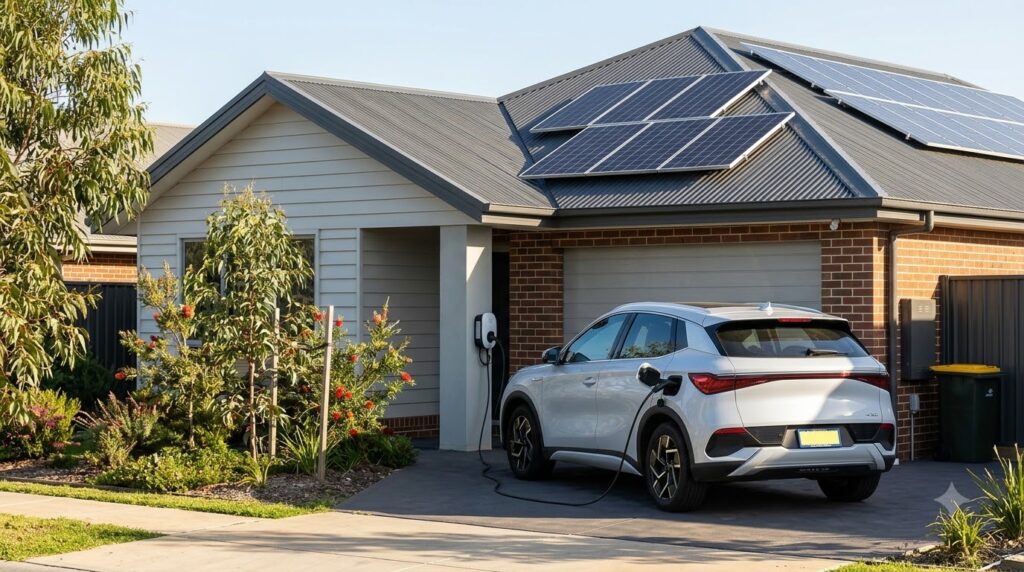
As electric vehicles become more popular across Australia, many homeowners are asking an important question: Can you charge an electric vehicle using solar power?
The answer is yes. If your home has a suitable rooftop solar system and an EV charging setup, solar-generated electricity can potentially be used to charge your electric vehicle during the day.
However, the amount of solar energy available for EV charging depends on several factors, including your solar system size, household electricity consumption, vehicle charging requirements, weather conditions and the time of day you charge.
At Nationwide Solar Pty Ltd, we help Australian homeowners plan solar and EV charging as part of one complete energy solution. With more than 10 years of solar industry experience, we understand how household electricity use, solar generation and EV charging can work together.
This guide explains how solar EV charging works and what Australian homeowners should consider.
How Does Solar EV Charging Work?
Solar panels generate electricity when sunlight reaches the panels.
That electricity can be used by appliances and equipment throughout the property, including an EV charger.
When your solar system is producing electricity and your EV is connected to a charger, some of that solar-generated electricity may be used to charge the vehicle.
For example, if your solar system is generating electricity during the middle of the day and your household is using less electricity than the system is producing, the available solar energy may contribute to charging your EV.
The amount available depends on what else is using electricity in the home at the same time.
Can an EV Run Completely on Solar Power?
In some situations, a large portion of EV charging may come from rooftop solar.
However, this depends on the individual household.
Important factors include:
- Solar system size
- Solar generation at the time
- Household energy consumption
- EV battery size
- Daily driving distance
- Charging speed
- Weather conditions
- Time the vehicle is connected
- Charger configuration
If your vehicle needs more electricity than your solar system is generating, additional electricity may be drawn from the grid.
This means solar and grid electricity can work together to charge the vehicle when required.
Why Solar and EV Charging Work Well Together
Electric vehicles can increase household electricity consumption, which makes solar an important consideration for many EV owners.
Without solar, most of the electricity used to charge an EV will generally come from the grid.
With rooftop solar, some of that electricity may instead be generated at home.
This can be particularly useful for households where the vehicle is parked at home during daylight hours.
Solar and EV charging may work well together because both technologies can form part of a broader household energy strategy.
Best Time to Charge an EV Using Solar
If your goal is to use more solar-generated electricity, charging during daylight hours is generally the most relevant time.
Solar systems typically generate the most electricity when sunlight conditions are strongest.
The exact generation profile depends on roof orientation, weather, shading and system design.
A household may choose to charge an EV:
- During the middle of the day
- While working from home
- On weekends
- When the vehicle is parked during daylight hours
- When solar generation exceeds normal household demand
The ideal charging schedule will depend on the household’s lifestyle.
How Much Solar Do You Need for EV Charging?
There is no single solar system size that is right for every EV owner.
The right system depends on both your household electricity usage and your vehicle charging needs.
Important factors include:
- How far you drive each day
- How often the EV needs charging
- Vehicle efficiency
- Household electricity consumption
- Available roof space
- Existing solar system capacity
- Future energy requirements
A household that drives short distances may require much less charging energy than someone who travels long distances every day.
This is why EV requirements should be included when planning a new solar system.
Planning a New Solar System for an EV
If you are installing solar and already own an electric vehicle, it is important to tell your solar provider about your EV charging requirements.
This allows the system to be planned with future electricity demand in mind.
A solar assessment may consider:
- Current household consumption
- Vehicle charging demand
- Available roof space
- Roof orientation
- Shading
- Charging times
- Future battery storage
- Possible second EV
Planning solar and EV charging together can help create a more coordinated household energy solution.
What If You Already Have Solar?
If your home already has rooftop solar, you may still be able to integrate EV charging.
The first step is understanding how much electricity your existing solar system generates and how much energy your household already uses.
If your system frequently produces additional electricity during the day, EV charging may allow you to use more of that generation on-site.
However, if your existing system is relatively small or household electricity consumption is already high, you may need to review whether the current setup is sufficient for your future EV requirements.
Nationwide Solar can assess an existing system and discuss possible EV charging options.
Choosing the Right EV Charger
The EV charger is an important part of the solar charging setup.
Different chargers may support different charging rates and features.
The right charger should be selected based on:
- Vehicle compatibility
- Home electrical capacity
- Charging requirements
- Existing solar system
- Parking location
- Future energy plans
A faster charger is not always necessary.
If your vehicle spends many hours parked at home, a lower charging rate may still provide enough energy for normal daily driving.
The most suitable charger is the one that matches your actual requirements.
Smart EV Charging and Solar
Some EV charging setups can offer smarter energy management options.
Depending on the charger and overall system, charging may be scheduled to take place during certain periods.
This can help homeowners align charging with solar production when practical.
For example, if your solar system generally produces strong output from late morning through the afternoon, your EV charging schedule may be adjusted to make better use of that period.
Available features depend on the charger and system configuration.
Can You Charge an EV at Night with Solar?
Solar panels do not generate electricity at night.
If you charge your EV overnight, the electricity will usually come from the grid unless another energy source, such as battery storage, is available.
Some homeowners consider battery storage as part of their solar and EV strategy.
A battery may store solar-generated electricity during the day for later use.
However, whether it is practical to use a home battery for EV charging depends on battery capacity, household demand, vehicle charging requirements and overall system design.
Solar Battery and EV Charging
Battery storage can add another layer to home energy planning.
A battery may help households use more solar electricity outside daylight hours.
However, an EV battery is much larger than many typical household batteries, so the amount of energy required for vehicle charging should be considered carefully.
When planning solar, battery storage and EV charging together, Nationwide Solar considers factors such as:
- Household electricity usage
- EV charging demand
- Solar system size
- Battery capacity
- Charging schedule
- Future electricity requirements
There is no one-size-fits-all solution.
Benefits of Charging an EV with Solar
Solar EV charging can offer several practical benefits.
These may include:
- Greater use of solar-generated electricity
- Reduced reliance on grid electricity during solar hours
- Convenient charging at home
- Better integration of household energy systems
- Support for future energy planning
- Increased use of renewable energy
The actual outcome depends on system design, driving patterns and household energy consumption.
Consider Future Energy Needs
An EV may not be the only change that increases your household electricity consumption.
You may also plan to add:
- A second electric vehicle
- More air conditioning
- Electric hot water
- Pool equipment
- Battery storage
- Additional appliances
- Home office equipment
These future changes should be considered when planning your solar system.
A system that is suitable today may need additional capacity if household energy demand grows significantly.
Residential Solar and EV Charging in Australia
Australia has strong solar resources, and many homes already have rooftop solar systems.
This makes solar and EV charging a natural combination for some households.
However, every property is different.
Roof size, orientation, shading, household consumption and driving habits all influence how well solar EV charging may work.
The best approach is to assess the home, vehicle and energy requirements together.
Complete Solar and EV Charging Solutions
Nationwide Solar Pty Ltd provides complete solar and EV charging solutions for Australian homes and businesses.
Our services can include:
- Household energy assessment
- Solar system review
- Custom solar system design
- EV and charger compatibility checks
- Electrical setup review
- Charger recommendations
- Professional EV charger installation
- Solar integration planning
- Future battery considerations
- Ongoing system guidance
With more than 10 years of solar industry experience, we focus on practical solutions designed around each property.
Why Choose Nationwide Solar Pty Ltd?
Nationwide Solar takes an integrated approach to solar and EV charging.
Instead of treating an EV charger as a separate product, we consider how it fits into the broader energy requirements of the home.
We look at:
- Solar generation
- Household electricity usage
- Vehicle requirements
- Charging habits
- Electrical capacity
- Future plans
This helps create a more suitable and coordinated energy solution.
Final Thoughts
Yes, you can charge an electric vehicle using solar power in Australia.
The key is having a solar system, EV charger and household energy setup that work well together.
Charging during daylight hours may allow you to use more electricity generated by your rooftop solar system, while the grid can supply additional energy when required.
If you are planning to install solar, buy an EV or add a home charger, considering all three together can help you make better long-term energy decisions.
Nationwide Solar Pty Ltd — Complete Solar and EV Charging Solutions for Australian Homes and Businesses.