
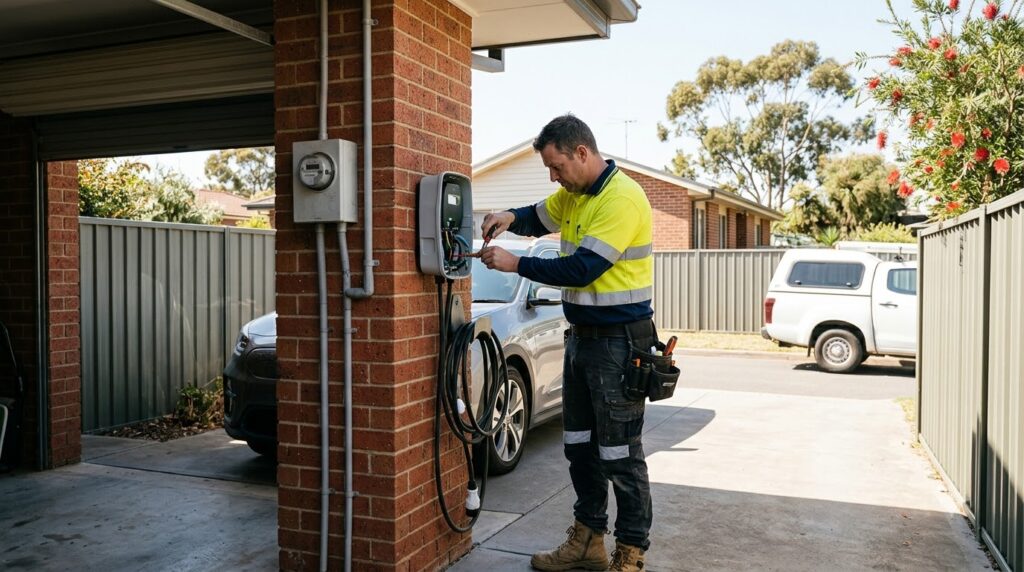
As electric vehicles become more common across Australia, more homeowners are looking for a convenient and reliable way to charge their cars at home. While some EVs can be charged using a standard power outlet, a dedicated home EV charger is usually a more practical solution for regular charging.
A properly planned EV charger installation should consider your vehicle, your home’s electrical capacity, charging habits, parking location, solar system and future energy needs.
At Nationwide Solar Pty Ltd, we provide EV charger solutions for Australian homes and businesses. With more than 10 years of solar industry experience, we understand how EV charging can fit into a broader home energy strategy that may also include rooftop solar and battery storage.
This guide explains what Australian homeowners should know before installing an EV charger at home.
What Is a Home EV Charger?
A home EV charger is a dedicated charging unit installed at your property to charge an electric vehicle.
It is usually mounted in a garage, carport, driveway or another suitable parking area.
A dedicated charger can offer a more convenient charging setup compared with relying only on public charging stations or a general-purpose power outlet.
The best charger for your home depends on factors such as:
- Your EV model
- Charging compatibility
- Available electrical capacity
- Where the car is parked
- Daily driving distance
- Existing solar system
- Future battery plans
- Household electricity usage
This is why a property and electrical assessment should be completed before installation.
Why Install an EV Charger at Home?
One of the main advantages of a home EV charger is convenience.
Instead of visiting public charging stations regularly, you can plug in your vehicle at home when it suits your routine.
For many households, this means charging overnight or during periods when the vehicle is parked for several hours.
A home charging setup can also make it easier to manage your EV alongside your household energy consumption.
If you have rooftop solar, there may also be opportunities to charge your EV during daylight hours when the solar system is producing electricity.
Check Your EV and Charger Compatibility
Not every charger is suitable for every electric vehicle.
Different EVs can support different charging speeds and connector types.
Before installing a charger, Nationwide Solar can review your vehicle’s charging requirements and compare them with available charger options.
Important factors may include:
- Vehicle make and model
- Charging connection type
- Maximum charging capability
- Charger output
- Intended charging schedule
- Daily travel requirements
Choosing a charger that matches your actual needs is more important than simply selecting the highest-powered charger available.
Review Your Home’s Electrical Capacity
An EV charger adds additional electrical demand to your home.
That means the property’s electrical setup should be reviewed before installation.
The assessment may consider:
- Existing switchboard
- Available electrical capacity
- Main electrical supply
- Other high-load appliances
- Air conditioning
- Electric hot water
- Pool equipment
- Solar system
- Battery system
- Future electrical upgrades
This helps determine what type of EV charging solution is practical for the property.
In some cases, additional electrical work may be required before the charger can be installed.
Choose the Right Charger Location
The physical location of the EV charger is another important consideration.
Ideally, the charger should be positioned close to where the vehicle is normally parked.
Common installation locations include:
- Garage walls
- Carports
- Driveways
- External walls
- Dedicated parking spaces
The final location may depend on the distance from the switchboard, cable routing, weather exposure and ease of access.
A well-planned installation should make charging convenient while keeping the setup neat and practical.
Understand Your Charging Needs
Not every EV owner needs the same charging setup.
Your requirements depend largely on how you use your vehicle.
For example, someone who drives short distances each day may have very different charging needs compared with someone who regularly travels long distances.
Questions to consider include:
- How far do you drive each day?
- How often do you need to charge?
- Do you usually park overnight at home?
- Do you work from home during the day?
- Do you have rooftop solar?
- Will you add another EV in the future?
Understanding these habits can help determine the right charging solution.
EV Charging and Rooftop Solar
One of the most important considerations for Australian homeowners is how EV charging can work alongside solar.
If your home already has rooftop solar, charging your vehicle during periods of strong solar generation may allow you to use more electricity generated on-site.
The amount of solar electricity available for EV charging will depend on:
- Solar system size
- Time of day
- Household electricity consumption
- Weather conditions
- Vehicle charging requirements
- Charger settings
For example, if your solar system is generating more electricity than the household is using during the middle of the day, some of that available solar energy may potentially be directed toward EV charging.
This can be especially useful for people who work from home or have their vehicle parked at home during daylight hours.
Planning Solar Around a Future EV
If you do not yet own an EV but expect to purchase one in the future, it can still be useful to consider EV charging when installing a new solar system.
An electric vehicle can significantly increase household electricity demand.
By discussing future EV plans early, your solar system can be designed with a better understanding of future energy needs.
This may help you make more informed decisions about system size and overall home energy planning.
EV Chargers and Battery Storage
Some homeowners also consider battery storage alongside solar and EV charging.
A home battery can form part of a broader energy management system, although the right setup depends on the household’s consumption and goals.
Important factors include:
- When the EV is usually charged
- Solar generation
- Evening household demand
- Battery capacity
- Charging habits
- Electricity tariffs
There is no single combination that is right for every home.
Nationwide Solar can consider solar, battery storage and EV charging together when reviewing your future energy strategy.
Can You Charge an EV Overnight?
Yes, many homeowners choose to charge their EV overnight because the vehicle is usually parked for several hours.
However, whether overnight charging is the best option depends on your electricity plan, solar system and household usage.
If your main goal is to use more solar-generated electricity, daytime charging may be more suitable when practical.
The best charging schedule depends on your lifestyle and energy setup.
Is a Faster Charger Always Better?
Not necessarily.
A more powerful charger may charge the vehicle faster, but it may also require greater electrical capacity.
The right charger should match your EV, your driving needs and your home electrical system.
For many homeowners, the most practical solution is one that comfortably replenishes the vehicle’s typical daily energy use.
Choosing a charger based purely on maximum charging speed may result in unnecessary complexity or cost.
Professional EV Charger Installation
A dedicated EV charger should be professionally installed.
Installation needs to take into account:
- Electrical safety
- Charger location
- Cable routing
- Switchboard capacity
- Property layout
- Vehicle compatibility
- Manufacturer requirements
At Nationwide Solar Pty Ltd, we assess the property and charging requirements before installation.
The goal is to provide a neat, reliable and practical charging setup.
Future-Proofing Your EV Charging Setup
When installing an EV charger, it is useful to think about future requirements.
You may eventually:
- Buy a second EV
- Increase your daily driving
- Add rooftop solar
- Expand your solar system
- Install battery storage
- Upgrade other household appliances
Planning ahead can make it easier to create a charging solution that fits your long-term energy needs.
Home EV Chargers for Australian Conditions
Australian homes can vary widely in design, electrical capacity and parking arrangements.
Some homes have enclosed garages, while others use open driveways or carports.
Weather exposure, cable length, switchboard location and solar access can all affect the installation.
That is why EV charger installation should be assessed on a property-by-property basis.
Complete EV Charging and Solar Solutions
Nationwide Solar Pty Ltd offers complete energy solutions for Australian homes and businesses.
Our EV charging services can include:
- EV and charger compatibility checks
- Electrical setup review
- Property assessment
- Charger recommendations
- Professional installation
- Solar integration planning
- Future battery considerations
- Ongoing system guidance
With more than 10 years of solar industry experience, we understand how solar generation, EV charging and household energy usage can work together.
Why Choose Nationwide Solar Pty Ltd?
Nationwide Solar provides a practical and integrated approach to EV charging.
Rather than simply installing a charger, we look at the wider energy requirements of your home.
We consider:
- Vehicle requirements
- Electrical capacity
- Solar system
- Charging habits
- Property layout
- Future energy plans
This helps us recommend a solution that is better suited to the individual household.
Final Thoughts
Installing an EV charger at home can make electric vehicle ownership more convenient and easier to manage.
The right charging solution should be based on your vehicle, household electrical capacity, parking arrangement, daily driving requirements and future energy plans.
If you already have solar, or are planning to install solar, it is also worth considering how your EV charging setup can work with the electricity generated by your home.
A professional assessment can help you choose a charger that is practical, compatible and suitable for your property.
Nationwide Solar Pty Ltd — Complete Solar and EV Charging Solutions for Australian Homes and Businesses.