
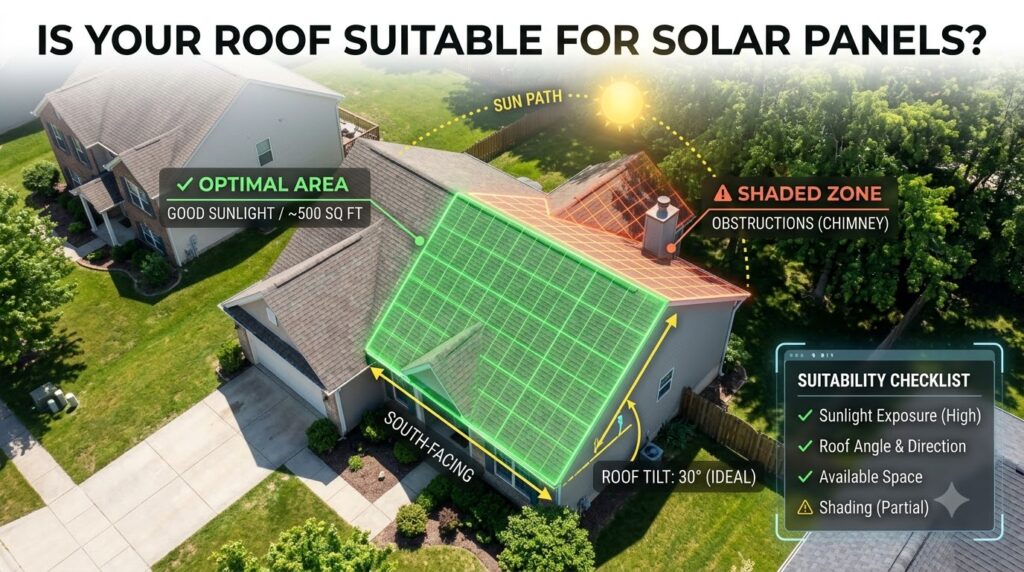
Is Your Roof Suitable for Solar Panels? A Complete Guide for Australian Homeowners
Before installing a residential solar system, one of the most important questions to answer is whether your roof is suitable for solar panels.
A roof may look like it has plenty of available space, but several factors can influence the final solar system design. Roof orientation, shading, condition, available area, pitch and existing rooftop equipment all need to be considered before installation begins.
At Nationwide Solar Pty Ltd, we assess the property before recommending a solar solution. With more than 10 years of solar industry experience, we understand that every Australian home has different roof conditions and electricity requirements.
This guide explains the main factors that determine whether your roof is suitable for solar panels and what homeowners should consider before choosing a residential solar system.
Why Roof Assessment Is Important Before Installing Solar
Solar panels are designed to operate for many years, so careful planning before installation is important.
The roof provides the foundation for the solar array. A good assessment helps determine where panels can be installed, how many panels may fit and which areas receive suitable sunlight.
A professional roof assessment may consider:
- Roof orientation
- Available roof space
- Roof pitch
- Shading
- Roof condition
- Roof material
- Skylights and vents
- Air conditioning units
- Antennas
- Access requirements
- Nearby trees and buildings
These factors help shape the final system design.
Does Roof Direction Matter for Solar Panels?
Roof orientation influences when panels receive sunlight throughout the day.
Different roof sections may produce electricity at different times.
For example, some sections may receive stronger morning sunlight, while others receive more sunlight later in the afternoon.
Rather than assuming only one roof direction is suitable, the entire property should be assessed.
A solar system may use one or several roof sections depending on:
- Household electricity usage
- Available space
- Shading
- Roof layout
- Desired system capacity
The best configuration depends on the individual property.
How Much Roof Space Do Solar Panels Need?
Available roof space influences how many solar panels can be installed.
However, not every part of the roof may be usable.
Space may need to be left around:
- Skylights
- Roof vents
- Chimneys
- Antennas
- Air conditioning equipment
- Roof edges
- Other obstructions
The dimensions of the selected solar panels also affect how they can be arranged.
This is why panel layout should be designed specifically for the roof rather than estimated only from the property’s total roof size.
Does Roof Pitch Affect Solar Installation?
Roof pitch refers to the angle or slope of the roof.
Australian homes have many different roof designs, ranging from relatively flat roofs to steeper pitched roofs.
The roof angle can influence:
- Panel positioning
- Installation method
- Access requirements
- Solar exposure
A professional installer considers the roof pitch when designing the mounting system and panel arrangement.
The goal is to create a practical installation that works with the existing roof structure.
How Does Shading Affect Solar Panels?
Shading is one of the most important considerations in solar design.
Trees, nearby buildings and rooftop structures may cast shadows over panels at different times of the day.
Potential shading sources include:
- Large trees
- Neighbouring houses
- Apartment buildings
- Chimneys
- Antennas
- Roof structures
Shade conditions can also change throughout the year as the position of the sun changes.
A roof assessment helps identify suitable areas and avoid unnecessary shading where practical.
Trees and Solar Panels
Trees can be beneficial around a property, but they may also affect rooftop solar.
A tree that does not create much shade today may continue growing and affect the system later.
When planning solar, homeowners should consider:
- Current tree height
- Tree location
- Future growth
- Seasonal leaf coverage
- Branches near the roof
This does not automatically mean trees need to be removed.
Instead, their impact should be considered when selecting panel locations.
Roof Condition Before Solar Installation
Solar panels are designed as a long-term installation.
For this reason, the condition of the roof should be considered before panels are installed.
If significant roof repairs or replacement are already expected, it may be more practical to address those issues before the solar system is installed.
Otherwise, panels may need to be temporarily removed later to complete roof work.
The roof should therefore be reviewed as part of the overall project planning process.
What Roof Types Can Have Solar Panels?
Solar panels may be installed on many common Australian roof types.
The installation method depends on the specific roof material and design.
Common residential roof types include:
- Metal roofing
- Tiled roofs
- Pitched roofs
- Some lower-slope roof designs
Each roof requires an appropriate mounting approach.
The property’s roof construction and condition should be assessed before installation.
Can a Small Roof Still Have Solar?
A smaller roof does not automatically mean solar is unsuitable.
The system may simply need to be designed more carefully around the available space.
For homes with limited roof area, system design may consider:
- Higher-output panels
- Multiple roof sections
- Efficient panel placement
- Household electricity requirements
The goal should be to use available roof space effectively rather than simply maximise the number of panels.
Multiple Roof Sections and Solar Design
Many Australian homes have complex roof designs with several separate sections.
Solar panels do not always need to be installed in one single block.
Depending on the property, panels may be distributed across several roof areas.
This can sometimes help:
- Increase available panel capacity
- Work around shading
- Match energy production to household usage
- Make better use of different roof orientations
A custom solar design helps determine the most appropriate arrangement.
Skylights, Vents and Other Rooftop Equipment
Modern homes can have several rooftop features that affect solar panel placement.
These may include:
- Skylights
- Air conditioning systems
- Ventilation outlets
- TV antennas
- Satellite dishes
- Roof access points
Solar panels need to be arranged around these features.
This makes accurate site planning particularly important for roofs with multiple obstructions.
Roof Access and Future Maintenance
Solar system design should also consider future roof access.
Over time, a property may require:
- Solar system inspection
- Roof repairs
- Gutter maintenance
- Air conditioning servicing
- Bird mesh installation
- Other rooftop maintenance
A practical solar layout should take access requirements into account where possible.
Planning these details from the beginning can make future maintenance easier.
Bird Activity Around Solar Panels
Solar panels create a small sheltered area between the panel and roof.
In some properties, birds may attempt to nest underneath this area.
Bird activity can lead to:
- Noise
- Nesting materials
- Droppings
- Feathers
- Additional cleaning requirements
Nationwide Solar provides bird mesh protection for solar panels to help restrict birds from accessing the area underneath new and existing systems.
If bird activity is common around your property, mesh protection can be considered as part of the solar installation.
How Much Solar Can Your Roof Support?
The amount of solar that can physically fit on the roof depends on the available space and panel dimensions.
However, the largest possible system is not automatically the right one.
The system should also be based on:
- Household electricity usage
- Daytime consumption
- Budget
- Future EV charging
- Battery plans
- Expected future electricity demand
Solar sizing and roof suitability should therefore be assessed together.
Consider Future EV Charging
If you expect to purchase an electric vehicle, tell your solar provider during the planning stage.
EV charging can increase household electricity usage considerably.
A larger solar system may be worth considering if:
- You plan to charge an EV at home
- The vehicle will often be at home during daylight hours
- You expect to own multiple EVs later
Available roof space can become particularly important when future electricity requirements are higher.
Consider Future Battery Storage
Battery storage may also influence how you plan your solar system.
While the battery itself does not necessarily require additional roof space, the amount of solar generation available can influence how much energy may be available for storage.
If you plan to install a battery later, this should be discussed during the initial solar assessment.
A Professional Assessment Helps Avoid Guesswork
Looking at your roof from the ground can provide a rough idea of available space, but it does not provide enough information for proper solar design.
A professional solar assessment considers the complete property.
Nationwide Solar can review:
- Roof area
- Roof orientation
- Shading
- Electricity usage
- System requirements
- Future energy plans
- EV charging needs
- Battery considerations
This information helps create a system design based on the actual property.
Complete Residential Solar Solutions
Nationwide Solar Pty Ltd provides complete solar solutions for Australian homes and businesses.
Our residential services can include:
- Property assessment
- Roof assessment
- Electricity usage review
- Custom solar system design
- Professional installation
- EV charging planning
- Battery considerations
- Bird mesh protection
- Solar monitoring guidance
- After-installation support
With more than 10 years of solar industry experience, we understand that every roof and household has different requirements.
Why Choose Nationwide Solar Pty Ltd?
At Nationwide Solar, we take a property-specific approach to solar.
Rather than recommending a standard package immediately, we consider the home, roof and energy requirements before developing a solution.
Our focus is on:
- Practical solar design
- Professional installation
- Suitable panel placement
- Future energy planning
- Ongoing support
This helps homeowners make a more informed solar decision.
Final Thoughts
Most homeowners considering solar should begin with a proper roof and energy assessment.
A suitable roof needs more than just empty space. Orientation, shading, condition, pitch, rooftop equipment and future energy requirements all need to be considered.
Even roofs with limited space or multiple sections may still offer useful solar opportunities when the system is carefully designed.
If you are considering rooftop solar, Nationwide Solar Pty Ltd can assess your property and recommend a solar solution based on your roof, electricity usage and future energy plans.
Nationwide Solar Pty Ltd — Complete Solar Solutions for Australian Homes and Businesses.