
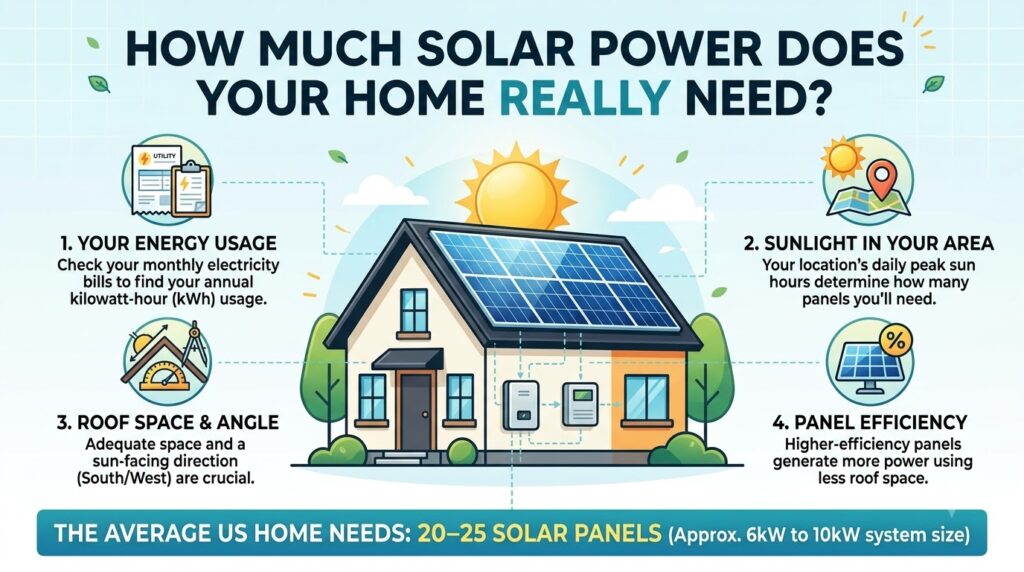
Choosing the right solar system size is one of the most important decisions for Australian homeowners considering rooftop solar.
A system that is too small may not generate enough electricity to meaningfully offset household usage, while a system that is much larger than your actual needs may not always provide the best value depending on how and when your home consumes energy.
The right solar size should be based on your electricity usage, roof space, daytime consumption, future plans and available budget.
At Nationwide Solar Pty Ltd, we assess each property individually before recommending a suitable residential solar system. With more than 10 years of solar industry experience, we understand that every household has different energy requirements.
This guide explains how to estimate how much solar power your home may actually need and what factors should be considered before installation.
Start with Your Electricity Bill
Your electricity bill is one of the best places to start.
It shows how much electricity your household uses over a billing period.
Important information may include:
- Total electricity consumption
- Average daily usage
- Seasonal usage changes
- Electricity tariff
- Peak and off-peak periods
- Solar exports if you already have solar
Average daily electricity use can provide a useful starting point when considering system size.
However, total consumption alone is not enough.
You also need to understand when that electricity is used.
Daytime Usage Matters
Solar panels generate electricity during daylight hours.
This means the more electricity your home uses while the sun is shining, the more solar electricity you may be able to use directly.
Typical daytime household loads may include:
- Air conditioning
- Pool pumps
- Washing machines
- Dishwashers
- Home office equipment
- Refrigerators
- Electric hot water
- EV charging
A home with high daytime consumption may benefit from a different solar setup compared with a home where most electricity is used at night.
That is why understanding your usage pattern is just as important as knowing the total amount of electricity you consume.
Consider Your Roof Space
The amount of usable roof space can influence how large a solar system can be installed.
Important factors include:
- Roof orientation
- Roof angle
- Roof shape
- Shading
- Skylights
- Chimneys
- Roof vents
- Air conditioning units
- Other rooftop equipment
A large roof does not always mean there is enough suitable space for a large solar system.
Some roof areas may receive too much shade or may not be practical for panel installation.
A proper roof assessment helps determine how much usable space is actually available.
Roof Direction and Solar Generation
Different roof sections receive sunlight at different times of the day.
This can influence how a solar system performs across the day.
For example:
- East-facing panels may receive more morning sun
- West-facing panels may receive more afternoon sun
- Other roof orientations may provide different generation profiles
The best arrangement depends on both the property and household electricity use.
For some homes, using multiple roof sections can help spread solar generation across more hours of the day.
How Many Solar Panels Do You Need?
The number of panels required depends on the total system capacity and the wattage of each panel.
However, panel count should not be the only focus.
A good solar system is not simply about fitting the maximum number of panels possible.
The design should consider:
- Household electricity consumption
- Available roof space
- Solar exposure
- Shading
- Inverter size
- Future energy demand
The goal is to create a system that is properly matched to the property.
Think About Future Electricity Usage
Your electricity needs may increase over time.
This is especially important because solar systems are long-term installations.
Future changes may include:
- Buying an electric vehicle
- Adding an EV charger
- Installing a swimming pool
- Adding more air conditioning
- Switching from gas to electric appliances
- Adding electric hot water
- Working from home
- Renovating the property
- Installing battery storage
If these changes are likely, they should be considered before choosing your system size.
A solar system designed only around your current usage may not fully meet your future needs.
Solar and Electric Vehicle Charging
An EV can significantly increase household electricity consumption.
If you already own an electric vehicle or plan to purchase one, your daily driving habits should be considered when planning solar.
Important questions include:
- How far do you drive each day?
- When will the car usually be charged?
- Will it be parked at home during the day?
- Will there be more than one EV in the future?
If the vehicle can be charged during daylight hours, it may be possible to use more solar-generated electricity directly.
Should You Oversize Your Solar System?
Some homeowners ask whether they should install a larger system than they currently need.
There can be reasons to consider additional capacity, especially if future electricity usage is expected to increase.
However, oversizing should be based on real plans rather than guesswork.
A larger system may make sense if you expect to:
- Add an EV
- Install a battery
- Increase electric appliance usage
- Expand the home
- Add a pool
- Increase air conditioning
The best approach is to discuss future demand during the system design stage.
Battery Storage and System Size
Battery storage can also influence solar system planning.
If you plan to install a battery, it may be useful to consider whether your solar system can generate enough electricity to charge the battery while also meeting daytime household demand.
Battery planning should consider:
- Solar production
- Household consumption
- Evening energy use
- Battery capacity
- EV charging
- Seasonal changes
Solar and battery systems should be designed together where possible.
Seasonal Electricity Usage
Household electricity use often changes throughout the year.
During summer, air conditioning may increase consumption.
In winter, electric heating may become the main load.
Other appliances may also operate seasonally.
A solar assessment should consider more than one electricity bill where possible.
Looking at usage across different seasons gives a more realistic picture of household energy demand.
Shade Can Reduce Available Solar Production
Shade from trees, nearby buildings or roof structures can affect how much sunlight reaches the panels.
This may reduce generation from certain roof areas.
Shading should be assessed at different times of the day and, where practical, across different seasons.
A roof that appears sunny in the morning may experience significant shade later in the day.
System design should take these conditions into account.
Is Bigger Always Better?
Not necessarily.
A bigger system may generate more electricity, but the best system is the one that aligns with your household energy requirements.
A properly sized system should consider:
- How much electricity you use
- When you use it
- How much roof space is available
- Whether you plan to add batteries or EV charging
- Your budget
- Your long-term energy goals
The goal should be balance, not simply maximum size.
Professional Assessment Makes a Difference
Estimating solar size online can be useful as a starting point, but it does not replace a proper property assessment.
A professional solar assessment can review:
- Electricity bills
- Daily usage patterns
- Roof layout
- Roof direction
- Shading
- Electrical infrastructure
- Future energy requirements
- EV and battery plans
At Nationwide Solar Pty Ltd, we use this information to develop a system recommendation based on the individual home.
Complete Residential Solar Solutions
Nationwide Solar Pty Ltd provides complete solar solutions for Australian homes and businesses.
Our residential solar service can include:
- Property assessment
- Electricity usage review
- Roof assessment
- Custom system design
- Professional installation
- Monitoring guidance
- Battery planning
- EV charging considerations
- After-installation support
With more than 10 years of practical solar industry experience, we understand that solar should be designed around the property rather than sold as a standard package.
Common Mistakes When Choosing Solar System Size
Homeowners can sometimes make decisions based on limited information.
Common mistakes include:
- Choosing a system only because it is cheap
- Ignoring future electricity usage
- Focusing only on panel count
- Not considering roof shading
- Forgetting about EV charging
- Not reviewing daytime energy use
- Ignoring battery plans
- Assuming every roof section performs the same
Avoiding these mistakes can help you make a more informed decision.
Final Thoughts
So, how much solar power does your home really need?
There is no single answer.
The right system depends on your electricity consumption, daytime usage, roof space, shading, future energy plans and budget.
The best approach is to start with your electricity bills, understand how your household uses energy and have your property professionally assessed.
A well-designed solar system should be sized around your real needs today while also considering how your energy requirements may change in the future.
If you are considering residential solar, Nationwide Solar Pty Ltd can assess your home and recommend a suitable system based on your property and electricity usage.
Nationwide Solar Pty Ltd — Complete Solar Solutions for Australian Homes and Businesses.